
Introduction
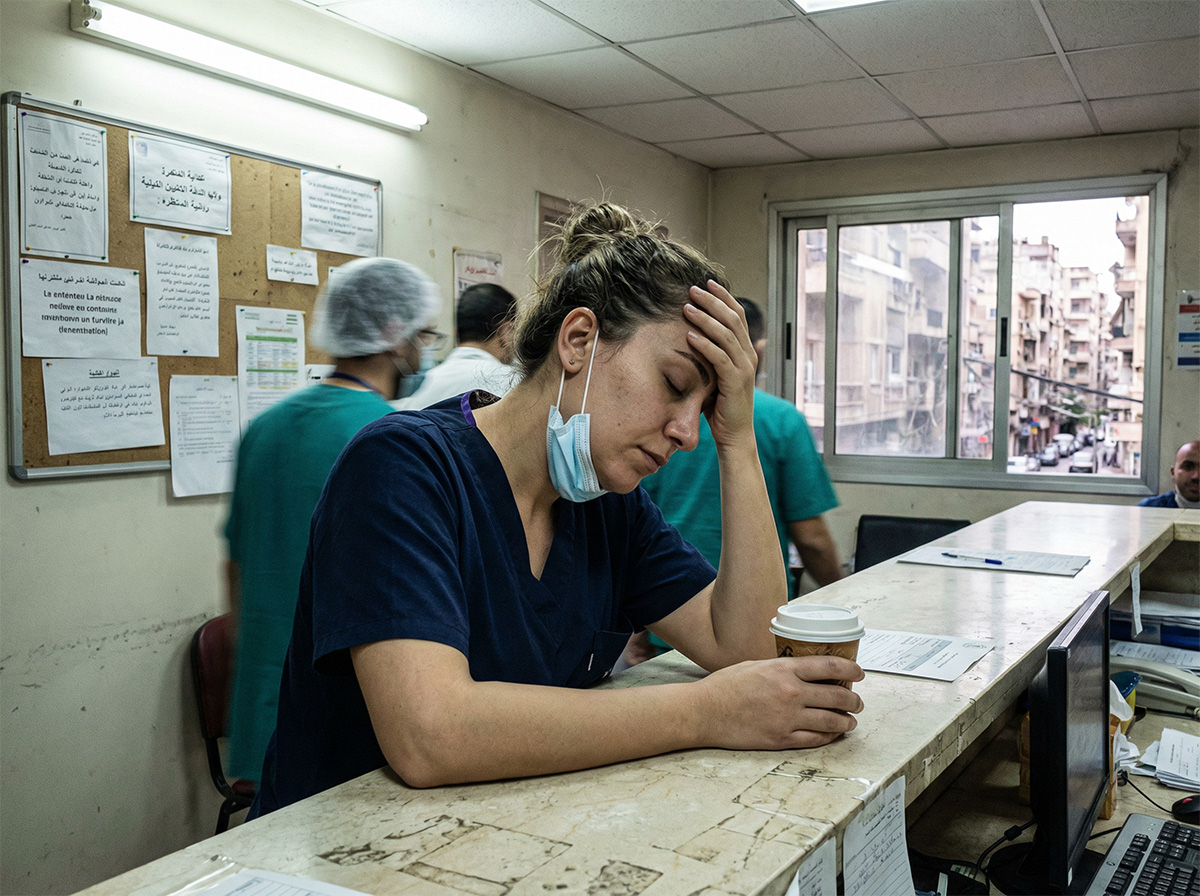
Healthcare professionals are trained to care for others — but who cares for them? Burnout among nurses, physicians, and allied health workers has reached alarming levels globally, and Lebanon is no exception. In a system already stretched thin by economic pressure, political instability, and the ongoing consequences of crisis, healthcare providers are carrying an invisible weight that rarely gets named — let alone addressed.
This article explores what burnout really looks like in clinical settings, why it is so often missed, and what professionals and institutions can do to respond before it reaches a breaking point.
What Is Burnout — and How Does It Differ from Stress?
Burnout is not simply feeling tired or overwhelmed. It is a recognized occupational phenomenon defined by the World Health Organization as resulting from chronic workplace stress that has not been successfully managed (WHO, 2019). Unlike acute stress — which is temporary and often resolves with rest — burnout represents a prolonged state of depletion that affects how professionals feel, think, and function.
Burnout is classically understood across three dimensions: emotional exhaustion, depersonalization (or cynicism toward patients and colleagues), and a reduced sense of personal accomplishment (Maslach & Leiter, 2016). When all three are present together, the impact on clinical performance — and on the individual — is significant.
The Scale of the Problem
Burnout in healthcare is not a niche concern. A systematic review and meta-analysis found that the pooled proportion of burnout among the public health workforce was 39% (Nagarajan et al., 2024).
In Lebanon specifically, the data is particularly stark. A meta-analytic study of 3,957 Lebanese healthcare workers found that burnout rates reached as high as 52%, with depression rates reaching 22.8% and stress rates as high as 80.6% during the COVID-19 pandemic (Ramzi et al., 2024).
Research among Lebanese oncologists reveals a troubling trend over time. A longitudinal study found a notable increase in burnout levels among Lebanese oncologists from 2018 to 2023, with emotional exhaustion and depersonalization significantly increasing while the sense of personal accomplishment decreased — attributed to systemic challenges, economic collapse, COVID-19, and the Beirut blast (Elias et al., 2025).
Warning Signs in Clinical Settings
Burnout rarely announces itself. It tends to develop gradually, often disguised as professionalism or resilience. Warning signs include:
- Persistent emotional exhaustion that does not improve with rest • Increasing emotional distance from patients — responding mechanically rather than compassionately • Cynicism or negativity about colleagues, patients, or the system • Declining sense of meaning or effectiveness in clinical work • Increased errors, reduced concentration, or avoidance of complex cases • Physical symptoms — insomnia, headaches, frequent illness
In a context like Lebanon — where crises have compounded over years — these signs may be normalized or dismissed. That normalization is itself part of the problem.
The Cost of Untreated Burnout
Burnout does not stay contained within the individual. Its consequences extend directly to patient care and institutional function. Research consistently links burnout to increased medical errors, reduced quality of clinical communication, higher rates of staff turnover, and patient dissatisfaction.
The study of Lebanese oncologists highlights the intricate relationship between economic challenges and mental well-being in healthcare professionals, noting that financial instability and systemic strain are key factors influencing both burnout and job satisfaction (Elias et al., 2025).
For institutions already struggling with depleted staffing and resource shortages, every healthcare worker lost to burnout represents an irreplaceable gap.
First Steps Toward Recovery and Sustainable Practice
Addressing burnout requires both individual and institutional action. At the individual level, early recognition is the critical first step — acknowledging that what you are experiencing has a name, is documented, and is not a personal failure. Professional supervision, peer support, boundaries around workload, and access to mental health care are all evidence-supported responses.
At the institutional level, the responsibility is equally clear. Monitoring staff wellbeing, building cultures of psychological safety, ensuring adequate supervision frameworks, and investing in professional development all contribute to reducing burnout prevalence.
Conclusion
Burnout among healthcare professionals is not inevitable — but preventing it requires deliberate, ongoing investment in the people who deliver care. Recognizing the signs early is the first, most essential step.
Blossomind Center’s Professional Wellbeing and Communication Skills Workshop equips healthcare professionals with practical tools to recognize, address, and prevent burnout in themselves and their teams. [Learn More →]
References
Elias, J., et al. (2025). Exploring burnout trends: A longitudinal comparative study of Lebanese oncologists in response to socioeconomic and pandemic challenges. PMC. https://pmc.ncbi.nlm.nih.gov/articles/PMC12174546/
Maslach, C., & Leiter, M. P. (2016). Understanding the burnout experience: Recent research and its implications for psychiatry. World Psychiatry, 15(2), 103–111. https://doi.org/10.1002/wps.20311
Nagarajan, R., Ramachandran, P., Dilipkumar, R., et al. (2024). Global estimate of burnout among the public health workforce: A systematic review and meta-analysis. Human Resources for Health, 22, 30. https://doi.org/10.1186/s12960-024-00917-w
Ramzi, Z. S., et al. (2024). The prevalence and determinants of mental health problems in Lebanon: A meta-analytic study of 3,957 healthcare workers. Turkish Journal of Psychiatry, 36, 150–163. https://doi.org/10.5080/u27427
World Health Organization. (2019). Burn-out an “occupational phenomenon”: International Classification of Diseases. Retrieved from https://www.who.int/news/item/28-05-2019-burn-out-an-occupational-phenomenon-international-classification-of-diseases